|
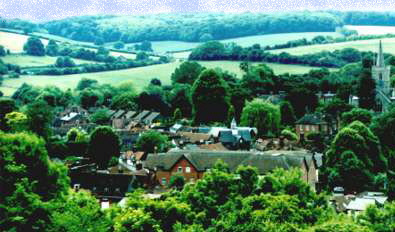
Chesham from 'The Balks' above the station looking South-West to the Pednor Valley. Pearce's roof is the dark, three-dormered one peeking through the trees in the bottom left.
|
Chesham History
Chesham has been around since the year dot. There is a prehistoric burial mound at the top of Lowndes Park (behind the pond). It must have been a tough bunch who roamed these deeply wooded and almost impregnable valleys 4000 years ago. There are the remains of a Roman Villa occupied up to the 2nd Century at Latimer and the arterial Akeman Street passed from St.Albans to Alchester through Berkhamsted to the North of Chesham so it is reasonable to assume Roman activity in the area. Customers also tell us of bits of hypocaust turning up in the gardens behind Church Street. The Saxon invaders settled in the 7th Century and named the village Ceastelshamm which, by the turn of the millenium, had mutated to Cestreham. A cosy division of woodlands and cultivation was overturned by the Norman conquest when, in time honoured tradition, the winner took all. Normans 1, Saxons 0. Indiginous Britons relegated to 20th division.
Markets and fairs became the focal point of economic activity under Norman rule and were eventually allowed only by charter from the Crown. In an echo of the official neglect of the town today, Chesham received its Charter in 1257 some 57 years after Amersham. Anyway, It seems that everything went swimmingly until the nasty old plague came along and pole-axed most economic activity in the middle of the 14th Century.
Activity grew again around the natural resources: the Chess river had been harnessed for milling and for growing cress; the surrounding woodlands gave timber leading to the local manufacture of such items as chair legs, brushes, shovels and spoons. Excavations during 1998 on the site of the new Sainsbury supermarket indicate a well developed tanning industry presumably resulting from the rearing of livestock on the cleared woodland. The tanning gave rise to a thriving boot and shoe industry.
Life carried on much the same, I guess, until the arrival of the railway in 1889. This heralded a profound change in composition and direction in the town. 'Newtown' was established and new estates marched over the countryside. The town changed from being a market town serving a local community to being a commuter town supplying products and people to the nearby metropolis.
|
|

|
|
©Pearces Hardware 2008
|

|
|
1.Home
2.How to find us
3.Buy from us
4.Chesham background
5.Pearces background
6.About this site
7.Weblog
|

|